Simulation Study: Isaac supports Pre-Surgery Consultations at University Hospital in Zurich - Less Typing. More Patient Time.

Doctors spend a huge part of their day typing. In many hospitals, up to half of a physician’s work time goes into documentation instead of interacting with patients. That’s not just frustrating — it contributes to stress, fatigue, and burnout.
A newly published simulation study from anesthesiologists at the University Hospital Zurich tested whether an AI-powered documentation assistant - Saipient's Isaac - could change that during pre-anesthesia consultations — the detailed medical conversations that happen before surgery.

The results are worth paying attention to.
1. Total Consultation Time Dropped by 18% — Because Documentation Got Faster
When doctors used the AI assistant, the total time from the beginning of the consultation until the report was finalized was on average 4 minutes shorter — an 18% reduction overall (statistically significant).
That doesn’t mean doctors rushed their patients. The data shows that the time savings came primarily from dramatically reduced documentation effort — not shortened conversations. With far less typing, clicking, and screen interaction, the entire process became more efficient.
Four minutes per consultation may not sound dramatic. But across dozens of consultations per week, that quickly adds up — creating meaningful capacity gains without cutting corners on patient care.
2. Doctors Looked at Patients — Not Screens
This might be the most striking result.
With AI support:
Screen time dropped by 78% (statistically significant)
Keyboard typing dropped by 87% (statistically significant)
Mouse clicks dropped by 19% (statistically significant)
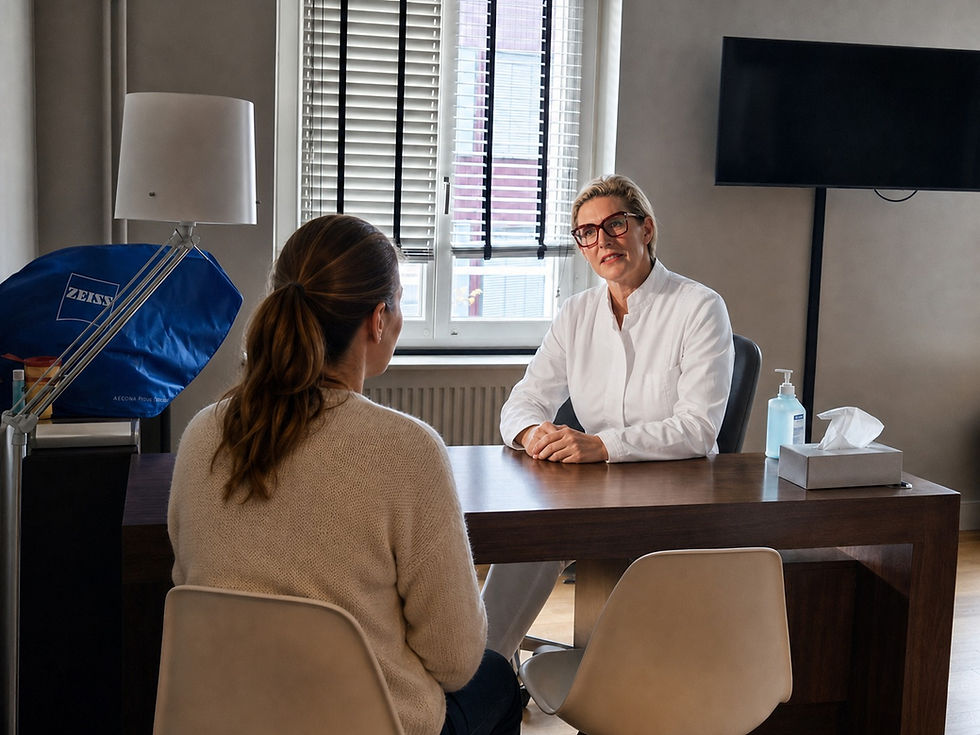
In other words: doctors weren’t glued to their monitors anymore. Instead of typing, clicking, and scrolling, they were free to focus on the person sitting in front of them.
That matters. Eye contact, body language, and undivided attention are essential in medical conversations — especially before surgery, when anxiety is often high.
3. Doctors Felt More Present With Patients
Doctors didn’t just spend less time on screens — they felt the difference.
When using AI:
They reported a significantly better ability to attend to patients
Ratings for quality of doctor–patient interaction were 21% higher
So this wasn’t just a technical win. It improved the human side of care.
4. Lower Mental Load
There was also a reduction in perceived workload (about 16% lower on a standardized workload scale). Although this was a trend rather than a clearly definitive statistical result, combined with the strong reductions in typing and screen fixation, the direction is consistent and encouraging.
Less multitasking.
Less cognitive strain.
Less documentation pressure competing with conversation.
In high-focus environments like anesthesia, reducing mental load is not a small benefit.
5. Most Doctors Preferred AI Support
When asked what would help them most during pre-anesthesia consultations:
60% chose AI assistance
Only 20% preferred secretarial support
The rest chose other options
That says something important: this was not imposed technology. Most clinicians actively preferred it.
A critical point: documentation quality, and how it was addressed in the product development
Independent experts rated manual reports higher overall, driven mainly by conciseness (significant) and a trend for better organization. Importantly, for the other quality dimensions—including “Accurate” (central in any hallucination discussion), “Up-to-date”, “Thorough”, “Useful”, “Comprehensible”, “Synthesized”, and “Internally consistent”—there were no statistically significant differences between AI and manual reports. Since the study was conducted in 2024, Isaac’s underlying models and prompt logic have been iterated, specifically to improve structure and brevity, i.e., the exact areas highlighted by reviewers.
Why This Matters
Healthcare systems are facing the same pressures: a growing documentation burden, rising clinician burnout, reduced time for meaningful patient interaction, and persistent staffing shortages. This study points to a very practical takeaway: AI doesn’t need to replace doctors — it can support them. By reducing typing, cutting screen fixation, lowering cognitive strain, and freeing up attention for patients, AI-assisted documentation can meaningfully improve the day-to-day reality of clinical work.
Sometimes innovation isn’t about doing more. It’s about letting professionals focus on what actually matters.
And in medicine, that’s the patient.
If you want to see Isaac live in action book a demo here: https://www.saipient.ch/blank-1

Link to full study: https://www.sciencedirect.com/science/article/pii/S0952818026000413