
How do patients experience AI-assisted documentation during consultations?
Updated: 23 hours ago
PATIENT EXPERIENCE SURVEY
A patient survey shows: AI-assisted documentation can make reports easier to understand, provide clarity without reducing trust.
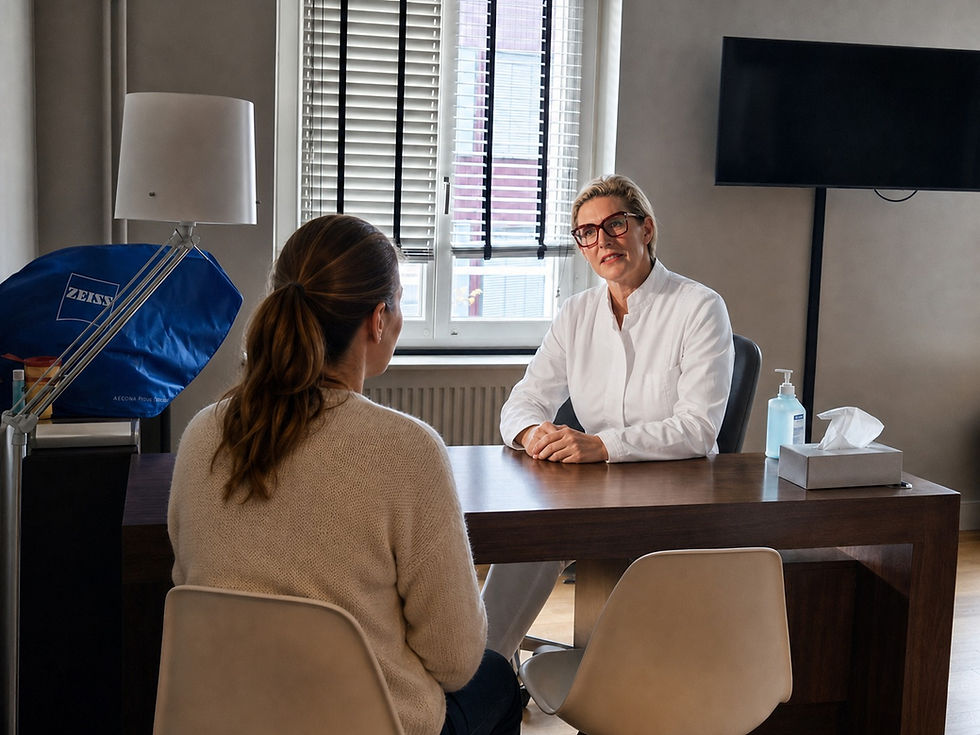
Prof. (UNIC) Dr. med. Bettina von Seefried, Cosima von Seefried and the Saipient team
Key results at a glance
How do patients experience AI in the consultation room?
When a practice considers using AI in consultations, technology is rarely the first concern. The most important question is: how do patients experience the situation when an AI assistant is being used in the consultation room?
Will patients continue to trust their doctors? Will they feel observed? Or will the conversation improve because the doctor has to type less and can pay more attention to the patient?
These are exactly the questions that gynhealth AG and Saipient examined in a survey. During the consultation, Isaac was used in the background to record the conversation and generate a structured medical report from it. The patients then received this AI-generated report by email together with a short questionnaire. This allowed them to assess directly whether the report was clear and helpful and how they experienced the use of Isaac during the consultation.
Setting | Gynecological consultations at gynhealth AG in Zurich, Dietikon, Olten and Winterthur |
Participation | 26 patients answered ten structured questions and two open questions |
Period | Responses were collected between May 4 and May 15, 2026 |
1. Patients found the report easy to understand
A consultation report is only valuable for patients if it is not only medically correct but also written in clear language.
77% | rated the report as very easy to understand |
19% | rated the report as easy to understand |
0% | found the report difficult to understand or unclear |
The feedback shows: Isaac can create reports that work well both for medical documentation and for patients. Such feedback is particularly valuable. It shows where patient-friendly language can be simplified further.
2. The report deepened understanding of the consultation
For many patients, the report was not simply a copy of the conversation. It helped them go over the most important points of the consultation again at their own pace.
62% | felt better informed by the report |
31% | answered “rather yes” |
0% | said the report was not helpful |
This means the report remains useful after the consultation. Patients go home not just with a memory of the conversation but with a written summary that they can read again later.
3. Most patients did not notice Isaac at all
A common concern is that AI in the consultation room could feel disruptive or unnatural. The pilot showed a different picture:
69% | did not notice that an AI assistant was active |
31% | noticed that Isaac was being used |
82% | of this group found the situation more pleasant because the doctor was able to focus more on them |
The dynamic is clear: if Isaac is not noticed, it causes no disruption. If patients do notice it, it can even have a positive effect, because the doctor’s attention visibly stays with them.
4. Trust increased or stayed the same
For every practice, the question of trust is central. The results here are particularly clear.
52% | said their trust in the doctor had increased |
48% | said their trust had remained unchanged |
0% | reported decreased trust |
Not a single patient reported a loss of trust. For around half of the patients, the transparent written report even actively strengthened the doctor-patient relationship.
“Perfectly worded. It was complete. I am satisfied with it as it is.”
5. The report confirmed the conversation
For most patients, the report served above all as a reminder and as reassurance. It confirmed that they had understood the consultation correctly.
65% | said the report confirmed that they had understood everything correctly |
23% | were able to understand the content better as a result |
4% | learned something new about their health |
0% | said the report was not helpful |
6. Patients want such reports as standard
When asked whether they would like to receive such summaries after every consultation in the future, the signal was very clear:
85% | said yes |
15% | said maybe |
0% | said no |
Not a single patient rejected the idea of receiving a clear report after the consultation.
What this means for doctors and practices
The key insight from the pilot goes beyond the question of whether patients or doctors benefit from AI-assisted documentation. What matters is that the same process brings both perspectives together while improving the quality of medical documentation.
This is where the real value lies: when Isaac captures the consultation in the background, more relevant details are preserved. Nuances in the patient’s account, the doctor’s follow-up questions and clinically important context can be systematically included in the patient record. Over time, this creates more reliable longitudinal documentation of the treatment history.
Why this matters
AI in the consultation room is often discussed mainly from the doctors’ perspective: less typing, less administrative burden and more time for patients. These benefits are real and clearly noticeable in practice.
However, the patient survey at gynhealth also shows the other side of this development: patients understand the reports, feel better informed and do not perceive the use of Isaac as disruptive. Their trust remains stable or even increases. At the same time, many would like such reports to become standard in the future.
Innovation in healthcare is often described as a trade-off: efficiency or humanity, technology or trust, time savings or quality. The data presented here suggest that this trade-off is not inevitable.
Used correctly, AI-assisted documentation can create added value for everyone involved: doctors gain relief, patients experience clearer follow-up, and practices get a more structured basis for documentation.
Would you like to find out how Isaac can support AI-assisted documentation in your practice? Click here to arrange a personal conversation with Saipient.
About the authors
Prof. (UNIC) Dr. med. Bettina von Seefried is co-founder and Chair of the Board of Directors of gynhealth AG, a network for gynecology and obstetrics with locations in Zurich, Dietikon, Olten and Winterthur.
Cosima von Seefried is a project manager at gynhealth AG.
Saipient AG, based in Zurich, develops Isaac, an AI-powered clinical documentation and productivity platform for Swiss healthcare providers.
Methodology
26 gynhealth patients answered a questionnaire with twelve questions after consultations in which Isaac was used in the background. The patients received the generated consultation report by email together with the survey. Responses were collected between May 4 and May 15, 2026.


